 Black Dog Exteriors
Four ways to dress up concrete
Broom finish is our standard on every job. It's simple, grippy and the cheapest to install. When you want something with more character, we pour four decorative options: stamped, exposed aggregate, salt finish and integral color. Some of these combine well, like integral color under a stamp or under a salt finish.
The structure underneath doesn't change. You still get a compacted base, 4 inches of 3,500 PSI ready-mix, rebar on 18-inch centers set on chairs and properly placed control joints. The finish is only the top layer. If you want the details of the slab itself, start with our spec in the concrete guide.
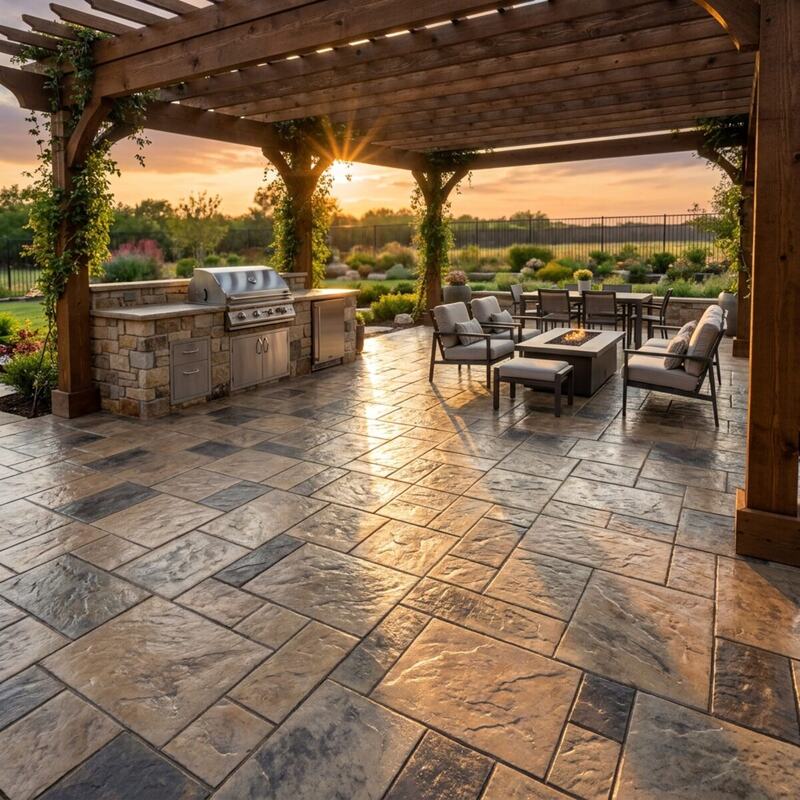
What each one looks like
Stamped concrete
The crew presses large rubber mats into the surface while the concrete is still soft. The mats leave a pattern, usually stone, slate, brick or wood plank. Color goes in the mix, on the surface or both, and a contrasting release gives the joints and low spots some depth. When it's done right it reads as stone from the street. Stamped work takes 2 to 3 days and includes the sealer.
Exposed aggregate
Right after the pour, the top layer of cement paste is washed off to show the stones in the mix. You get a pebbly, natural look with plenty of texture underfoot. It hides dirt well and grips well when wet, which is why people like it around pools.
Salt finish
Coarse rock salt is pressed into the surface and then washed out once the concrete sets. It leaves small, shallow pits scattered across a smooth face. It's subtle, a step up from broom without looking busy, and it stays comfortable for bare feet.
Integral color
Pigment is mixed into the whole batch at the plant, so the color runs all the way through the slab. A chip or a scratch shows the same color underneath. It works on its own with a broom or salt finish, or as the base color under a stamp.
How they compare
| Finish | Look | Upkeep | Cost vs broom |
|---|---|---|---|
| Broom | Plain gray, fine texture | Wash it now and then | Baseline |
| Salt finish | Smooth with small pits | Low | More |
| Integral color | Even color all the way through | Low; color mellows with sun | More |
| Exposed aggregate | Pebbly, natural stone | Low to moderate | More |
| Stamped | Stone, slate, brick or wood pattern | Reseal every few years | Considerably more |
Decorative and stamped work costs considerably more than broom. Your estimate prices the finish as its own line so you can see the difference.
Sealing and upkeep
Stamped concrete is the one that needs real attention. The sealer protects the color and keeps the surface from wearing, and it's what gives stamped work its rich look. We put the first coat on as part of the job. Plan on resealing every few years. Sun and foot traffic wear it down, and you'll notice the color going flat when it's time.
Sealer needs 48 dry hours to cure. Keep furniture off decorative finishes for 7 days. You can walk on it after 24 hours.
A sealed surface can be slicker when it's wet. On a patio that's usually fine. On a pool deck or a sloped walk, we'd point you toward salt finish or exposed aggregate. Our pool deck page covers that in more detail.
Where decorative finishes aren't allowed
The apron, the strip of driveway between the street and the sidewalk, belongs to the city in most places. Some cities want it plain broom finish no matter what the rest of the driveway looks like. Flower Mound and University Park both do. A stamped driveway with a broom apron at the street is a common look for that reason.
Rules differ by city, and they change. We check before we draw up your estimate so you don't get a surprise at inspection. The DFW driveway replacement page has more on city rules, and the apron section of the guide explains why aprons are built differently.
Matching existing stamped concrete
This comes up a lot with extensions and repairs. Someone has a stamped patio and wants to add 10 feet to it. The honest answer is that an exact match is hard to get.
- Pattern mats vary between manufacturers, and older patterns may not be made anymore.
- Color on the old slab has faded and weathered for years. New color starts out brighter.
- Old sealer has worn differently in sun and shade, so the old slab isn't even one color anymore.
What usually works better is a planned break. A border band in a contrasting color or a plain finish between old and new reads as a design choice instead of a mismatch. If the old slab is in rough shape anyway, replacing the whole area and stamping it fresh gives you one consistent surface. We'll look at photos and tell you which way we'd go.
Getting a decorative estimate
Send us photos and tell us which finish you're leaning toward. If you're torn, ask us to price two. We measure from aerial imagery and your photos and usually have a written, itemized estimate to you within one business day, confirmed by a 20-minute walk on site. Estimates are good for 30 days.
Start your estimate and mention the finish and color you have in mind.
Questions people ask
How often does stamped concrete need to be resealed?
Every few years. The sealer protects the color and the surface, and fresh sealer keeps the pattern looking sharp. We include the first coat.
Is stamped concrete slippery?
Sealed stamped concrete can be slicker than broom when it's wet, especially around a pool. For a pool deck, salt finish or exposed aggregate usually grips better.
Can my city's apron be stamped?
Some cities want a plain broom finish on the apron at the street. Flower Mound and University Park are two of them. We check your city's rule before we draw up the estimate.
Can you match my existing stamped concrete?
Getting an exact match is hard. Patterns, color and years of weathering all play in. We'll look at it and tell you honestly how close we can get, or suggest a border or a clean break instead.
Get your driveway priced
No sales visit to get a number. Most people have a written estimate within a day.
Or call or text (903) 418-2989