
Start to finish
How it works, step by step
From the moment you send us your project to the day you walk the finished slab, here's the whole path. Most driveways pour two to three weeks after you accept, depending on permits and weather.
- You send the detailsAddress, what you want done, and a few photos. That's all we need to start.Day 0
- We measure and price itWe trace your project on high-resolution aerial imagery and build an itemized written estimate, usually within one business day.Day 1
- You accept and lock it inPick your option, then a $250 deposit locks your price and your spot in line. It comes off your bill.When you're ready
- A quick walkAbout 20 minutes with a tape. We confirm measurements, access, grade, sprinklers and anything the photos couldn't show.Before work
- Permit and 811We pull the city permit and call 811 so public utility lines get marked. You flag private lines like sprinklers.Week 1-2
- Payment 2, crew mobilizesHalf the price, less your deposit, before the crew rolls. That books the concrete, steel and crew.Before day one
- Tear-out, base, forms, steelOld concrete out and hauled off, base compacted, forms set, rebar tied and lifted on chairs. Some cities inspect here.Day one
- Pour and finishConcrete placed, finished, joints cut, curing started. Most broom-finish jobs take one to two days total.Day one or two
- CureWalk on it after 24 hours, drive on it after 7 days, keep heavy trucks off for 28.Days 1-28
- Final walk, then final paymentYou walk the finished work with us. The last payment is due on completion, once you've seen it.Completion
- Warranty startsOne year of written workmanship coverage from the day we finish.Year one
- Questions anytimeText the same number the whole way through. You won't get bounced around.(903) 418-2989
How can you measure my driveway without coming out?
We trace your project on current high-resolution aerial imagery, the same kind of imagery engineers and roofers use, and calculate square footage from the outline. Your photos fill in what the sky can't show: cracks, steps, slopes, where the old slab meets the house.
That gets you an accurate written price fast without anyone taking a morning off work for a sales visit. Before any work starts we still do a short walk with a tape measure to confirm everything on the ground. If something changes the price, like a slope that needs extra base or an area we couldn't see under a tree, you see the new number in writing before we start, and you can still walk away with your deposit.
How fast will I get my estimate?
Usually within one business day once we have your address and photos. Every estimate is checked by a person before it goes out, so a big or unusual project (a long commercial drive, a culvert, a pool deck) can take a little longer. If you haven't heard from us in two business days, check your spam folder, then text us.
Why does my estimate show more than one option?
When a project has natural pieces (a driveway plus a walkway, or a patio plus an extension) we price them so you can choose. Each option shows exactly what's included, and the "all of it" option is usually the best price per square foot because the crew, truck and setup only happen once. Extras like a thicker slab, a pump or a decorative finish are listed on their own lines so you can see what each one costs.
How soon can you start?
Most jobs pour two to three weeks after you lock in, sometimes a little longer. The main variables are the city permit (some cities turn them around in a day, a few take 7 to 10 business days) and weather. Your deposit can hold today's price while you pick a date that works for you.
How long will the job take, and how long will I be without my driveway?
A broom-finish driveway is usually one to two days of work: tear-out and prep, then the pour. Stamped or decorative work runs two to three days. After the pour, plan on 7 days without parking on it, so line up street parking or a neighbor's drive for a week. You can walk on it after 24 hours.
Who actually does the work?
Your job is built by experienced specialist concrete crews working to our spec and under our supervision. Your agreement, your invoice, every payment and your warranty are with Black Dog Exteriors, and Black Dog stays responsible for the work. We carry general liability insurance and can send a certificate on request.
One rule worth knowing: never pay a crew member directly, in cash or any other way. All payments go to Black Dog through your invoice. If anyone on site asks you for money, text us.
Do you do foam leveling, overlays or patch repairs?
No, and it's on purpose. We replace concrete. Overlays and resurfacing coats tend to peel and crack on top of a slab that's already failing, and we can't put a warranty on them. Patching a few panels leaves seams that move differently from the old concrete. Foam or mud lifting can buy time on a slab that's sound but sunken; if that's really what you need, we'll tell you and point you to someone who does it well.
What you're paying for
Our standard spec, and the reason for each piece
Every Black Dog driveway starts from the same build. It's written on your estimate, so you can hold any other bid up against it line by line.
Graded and compacted, not just raked flat. Weak base is the number one reason slabs sink.
Ready-mix from a plant, batched to strength. Not bagged, not watered down on site.
A tied grid in both directions, lifted on chairs so it ends up inside the slab, where it works.
Control joints so cracks happen in a straight line where we want them. Expansion joints where new concrete meets old.
Steel dowels drilled into concrete that stays, like a garage slab or the street gutter, so the two can't separate.
A non-slip broom texture. Old concrete torn out and hauled off. Your yard left clean.
Why does the base matter so much?
Concrete doesn't hold itself up. It spreads your car's weight onto whatever is underneath. If that ground is soft, loose or has voids, the slab bridges over the weak spot until it can't, then it cracks and drops. That's what most "my driveway sank" photos are.
We strip the old slab, fix soft spots, bring in base where the grade needs it and compact it. This is also where cheap bids save money: grading dirt flat and pouring on it looks identical on day one. You find out the difference in year two.
What are control joints and expansion joints?
All concrete shrinks a little as it cures, and on clay it moves with the seasons. That stress has to go somewhere. Control joints are straight cuts about a quarter of the way into the slab. They create a weak line so the crack happens inside the joint, straight and hidden, instead of wandering across the middle of a panel.
The industry rule is to space them about 2 to 3 times the slab thickness in feet, so roughly every 8 to 10 feet on a 4-inch driveway, and to keep panels close to square. Expansion (isolation) joints are a soft strip where the new slab meets something it shouldn't be locked to, like the old concrete, the garage or the house, so each can move on its own.
No joints, or joints spaced too far apart, is one of the most common mistakes on cheap jobs. The slab will crack anyway, just in the wrong places.
What are dowels, and why do you drill into my garage slab?
Where a new slab meets concrete that's staying (your garage floor, a porch, the city gutter), we drill in short steel bars that reach into the new pour. They keep the two surfaces level with each other so you don't get a lip or a trip edge as the ground moves. It's a small step and it's often skipped.
Is tear-out and haul-off included?
Yes, on every replacement. We remove the whole existing slab and its old steel, not just the top layer, and haul it away. Extra demo outside your project area (an old shed pad, say) is quoted as its own line.
Reinforcement
Rebar has to be inside the slab to work
"We use rebar" doesn't tell you much. Steel lying in the dirt under the concrete does almost nothing. What matters is where it ends up after the pour, and that's what chairs are for.
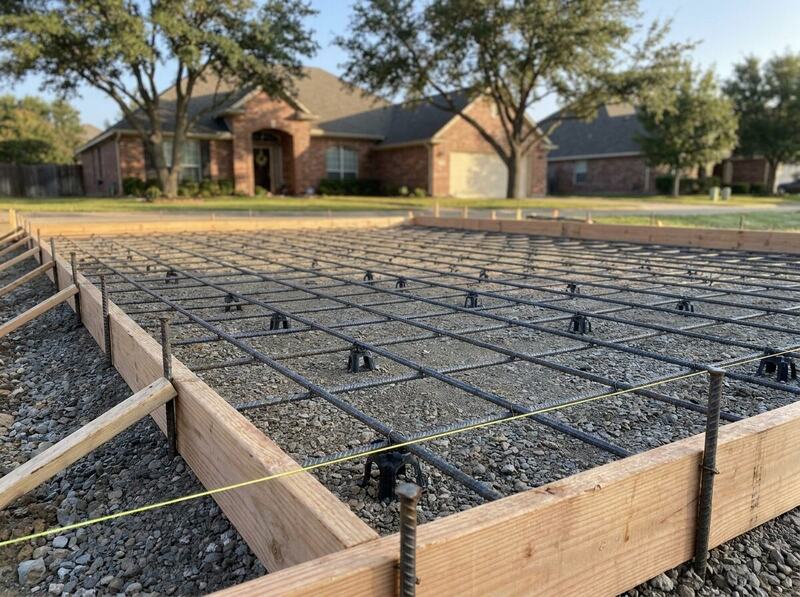 Steel tied and lifted on chairs before the pour
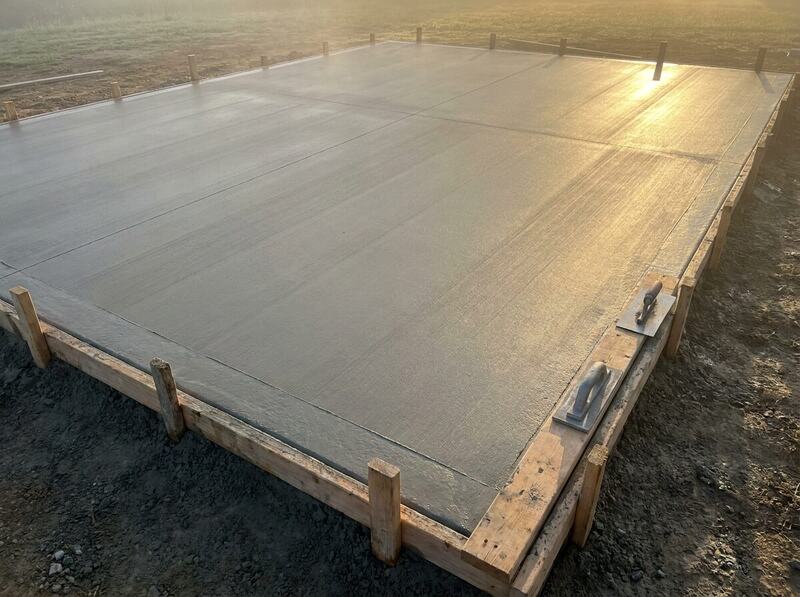 Finishing after the steel is buried in the slab
Why does rebar need to be on chairs?
Rebar doesn't stop concrete from cracking. Nothing does. Its job is to hold a crack closed once it forms, so a hairline stays a hairline and the two sides can't drift apart or shift up and down. To do that, the steel has to be surrounded by concrete it can grip, roughly in the middle of a 4-inch slab.
Laid on the dirt, the bar ends up at the bottom edge of the slab or under it, where it can't grip anything. Some crews lay it flat and plan to "hook and pull" it up into the wet concrete as they pour. Industry guidance is blunt about that method: the steel almost never ends up where it belongs. Chairs put the steel at the right height and keep it there while people walk on it during the pour.
It matters enough that North Texas cities like Plano, Fort Worth and Royse City write chairs into their own concrete specs, and inspectors will stop a pour if the steel is on the ground.
Rebar, wire mesh or fiber: what's the difference?
- Rebar is solid steel bar tied into a grid. It's the strongest option for holding cracks tight and level, and it's what we use.
- Welded wire mesh is thinner steel in a sheet. It can work, but it's floppy and almost always ends up flattened against the ground during the pour.
- Fiber is mixed into the concrete. Small synthetic fibers mainly help with tiny cracks while the concrete is still setting. They're a fine add-on, not a replacement for steel.
Why an 18-inch grid? Would tighter be better?
An 18-inch grid in both directions is a solid residential standard for a 4-inch driveway on North Texas soil, and it matches or beats what most cities require for the public apron. Heavier use gets heavier steel: when you're parking an RV, trailer or work truck, we'll quote a thicker slab with tighter or heavier steel. More steel isn't automatically better, though. Too much continuous steel across a control joint can keep the joint from doing its job.
Strength
PSI, the mix, and why water is the enemy
PSI is how much pressure a sample of the concrete can take before it crushes, measured after 28 days of curing. Higher numbers come from more cement and less water in the mix. Here's how the common mixes line up.
What PSI do you use, and why 3,500?
Our standard driveway is 3,500 PSI ready-mix. Driveway guidance generally lands between 3,000 and 4,000 PSI, and 3,500 gives a real margin over 3,000 without paying for strength a passenger-car driveway doesn't use. Aprons at the street get 3,500 or 4,000 depending on the city. If you're parking heavy trucks, trailers or an RV, we'll recommend 4,000 PSI and a thicker slab, and price it as its own line.
What's actually in the mix?
Concrete is four things: cement (the glue), sand, rock (the bulk and the strength) and water (which reacts with the cement and hardens it). Ready-mix plants batch these by weight to a tested recipe for each PSI. Roughly speaking, a 3,000 PSI mix uses about five sacks of cement per cubic yard and a 4,000 PSI mix about six.
The number that matters most is the water-to-cement ratio. Less water means stronger, denser, longer-lasting concrete. More water makes it easier to pour and finish, and weaker.
Why shouldn't the crew add water to the truck?
Because it quietly downgrades the concrete you paid for. Adding water at the truck makes the mix flow easier, which saves the crew effort, but every extra gallon per yard weakens it, slows the set and raises the odds of shrinkage cracks and a dusty, flaking surface. The ready-mix industry's own guidance is to avoid water beyond the mix design and write any added water on the delivery ticket. Our crews pour the mix as designed.
Should I just pay for 4,000 or 4,500 PSI?
If you park normal cars and trucks, you don't need to. The upgrade makes sense for heavy vehicles, trailers, RVs, or a pad where a dually or work truck turns all day. For most homes, the money is better spent on what's under and inside the slab: base, steel and joints. If you want it anyway, we'll show the difference as its own line on your estimate.
Why not use bagged concrete for a small job?
Bagged mix is fine for a fence post. For a slab, it means mixing dozens or hundreds of batches by hand, each a little different, with seams where they meet. Plant ready-mix arrives as one consistent batch at a tested strength, so the whole slab cures together.
Thickness
4 inches on the drive, 6 at the street
The apron (cities call it the drive approach) is the piece between the sidewalk or property line and the street. It's built to a different standard than the rest of your driveway, and the city sets the rules for it.
Why are aprons poured 6 inches thick instead of 4?
Two reasons. First, the city requires it. Dallas, Fort Worth, Plano and most of the DFW cities we've checked spell out a 6-inch drive approach in their construction standards, with set rebar spacing and a minimum PSI, and several (Plano and Fort Worth among them) specifically require the steel on chairs. The permit inspector checks it.
Second, it's the piece doing the hardest work. The apron gets heavy trucks rolling over it, cars turning in at an angle, and it sits at the street edge, where water runs and the soil is least protected. A 6-inch slab carries far more load than a 4-inch one. We pour every apron at 6 inches with rebar on chairs and dowels into the gutter, whether or not your city checks.
Isn't the apron the city's responsibility?
It's a common belief, and in DFW it's usually wrong. The apron sits in the city's right-of-way, but in every DFW city we've researched that addresses it, replacing a homeowner's apron is the homeowner's cost. The city controls how it's built (permit, spec, inspection) and only rebuilds it on its own street projects. That's why we price the apron as its own line and pull the permit for it. If your city has already redone your apron recently, tell us and we'll leave it out.
Should I pour my whole driveway 5 or 6 inches thick?
For normal cars and pickups, 4 inches of 3,500 PSI concrete on a good base with steel on chairs is the right build. Going thicker uses 25 to 50 percent more concrete, so it raises the price noticeably. It's worth it if you park an RV, a boat, a trailer or heavy work trucks. We usually recommend 5 inches with heavier steel for that. We'll price it as an upgrade so you can decide.
One thing thickness won't fix: water getting under the slab. If a driveway failed because of drainage, the fix is drainage.
My apron is shared with my neighbor. How does that work?
Shared aprons come up a lot in older neighborhoods. Usually the neighbors split the shared section, and we can price your half and theirs separately. If both driveways are being done, a single trip for both is cheaper per square foot for everyone.
North Texas ground
Clay, cracks and settling
Much of Dallas-Fort Worth sits on Blackland Prairie clay, the same soil that keeps foundation repair companies busy. It swells when it's wet and shrinks when it's dry, and it does that every year. A slab here has to be built to live on ground that moves.
Will my new concrete crack?
Almost certainly, somewhere, eventually. Every concrete slab shrinks as it cures, and in North Texas it also rides on moving clay. Anyone who promises a crack-free driveway isn't being straight with you. The goal is control: thin cracks, inside the control joints where they're nearly invisible, held tight and level by the steel.
Normal: fine hairline cracks, especially along joints or at corners, that don't open wider or create a step. Not normal: cracks wider than about a quarter inch, cracks where one side sits higher than the other, or sections that sink. Those are what our warranty is for.
What makes a driveway sink or settle?
- Weak base. Loose fill, uncompacted dirt or old voids that compress under weight.
- Water under the slab. Downspouts dumping at the edge, poor slope, sprinkler leaks or a low spot that holds water. It softens the clay and washes out the base.
- Edges with nothing beside them. Soil erodes along an exposed edge until the slab overhangs and cracks.
- Trees. Big trees pull a lot of water from the ground, and roots can lift and crack panels. We cut roots under the slab area during tear-out.
- Old trenches or fill. Utility trenches, old pools or buried debris settle for years.
Most of these we fix at the base during your job. The ones on your side (downspouts, sprinklers, grading the yard so water runs away from the slab) are worth doing at the same time.
I see a hairline crack a week after the pour. Is something wrong?
A thin crack in the first weeks is usually plastic or drying shrinkage, the slab getting slightly smaller as water leaves it, especially in summer heat or wind. If it runs along or close to a joint and stays hairline-thin, it's cosmetic. Take a photo with a coin next to it and text it to us anyway. We'd rather look at it early, and a dated photo makes any warranty question simple later.
Will a new driveway fix my drainage problem?
It can help, because we slope the new slab to shed water away from the house and garage. It won't fix water coming from somewhere else, like a yard that drains toward the house or downspouts emptying onto the driveway. If drainage is part of the problem, tell us. A French drain, a channel drain or redirected downspouts may need to be part of the plan, and it's far cheaper to do that before the pour than after.
Can my driveway hurt my house foundation?
Not directly, but water is the link. A driveway that tilts toward the house, or traps water against the foundation, keeps the clay next to the house wetter than the rest, which is exactly the uneven moisture foundations hate. We slope driveways and patios away from the house and keep an isolation joint between the slab and the foundation, so the two can move on their own.
Paperwork
Permits, the city and 811
Nearly every DFW city requires a permit for a new drive approach, and many want one for driveways, patios and flatwork too. We handle it. Here's what that involves and what you might see.
Application, site plan and scheduling the inspection. City fees are passed through at cost, usually zero to about $300.
Texas law requires a locate before digging. Public utilities (gas, electric, water, cable) get marked with paint and flags.
811 doesn't mark what's yours: sprinklers, landscape lighting, septic, pool lines, invisible dog fence. Flag them or point them out at the walk.
If you have an HOA, check whether it needs to approve a new driveway or a color change. We can send drawings and specs for the application.
Do you pull the permit, and what does it cost?
Yes. We apply, we schedule the inspections, and we bill the city's fee at cost with no markup. In most cities that's free or under $300. Some cities also require the contractor to be registered or bonded with them before they'll issue a permit for work in the right-of-way, which is one more reason to hire someone who pulls permits regularly.
Can we skip the permit to save time?
We don't. An unpermitted apron can get a stop-work order or a demand to tear it out, it can come up when you sell the house, and the inspection is real protection for you: an inspector checking the forms and steel before the pour is a second set of eyes on the parts you can't see later. If a contractor offers to skip it, ask what else they skip.
What happens at the inspection?
Many cities send an inspector after the forms and steel are set and before the concrete goes in. They check thickness, that the steel is on chairs, the base and the joint at the property line. If they want something changed, we change it and they sign off. Occasionally an inspection slot pushes your pour back a day. That's the city's calendar, and we'll tell you as soon as we know.
I want a new or wider driveway that needs a curb cut. Can you do that?
Often, yes, but it's the most regulated kind of drive work. Cutting a city curb or sidewalk needs approval from the city's engineering or public works department, and some cities (Fort Worth and Dallas, for example) only issue those permits to registered, bonded contractors. Tell us early, and we'll check what your city requires before we price it.
I'm outside city limits. Do I still need a permit?
In unincorporated county areas there's often no driveway permit or inspection, though you may still need county approval for anything touching a county road, a culvert or a bar ditch. We build to the same spec either way.
Price
What drives the price, and why small jobs cost more per foot
A concrete price is mostly three things: concrete and steel, which scale with size; labor and equipment, which scale partly; and fixed costs that are the same whether we pour 200 square feet or 1,200. That last bucket is why a small slab costs more per square foot.
Why does a small slab cost almost as much as a bigger one?
Because most of the cost of showing up doesn't shrink with the slab. A crew still loses a day, the excavator and dump trailer still make the trip, forms still get set, the permit still gets pulled. On top of that, ready-mix plants are built to deliver full trucks (around 9 to 10 cubic yards). Smaller orders get a short-load charge because the plant runs a full truck and driver to deliver a partial load.
For scale: one cubic yard covers about 80 square feet at 4 inches thick, so a 300-square-foot pad is under 4 yards, a short load, while a 900-square-foot driveway is about 11 yards. That's why small jobs carry a project minimum, and why adding a walkway or patio to a driveway job is often surprisingly cheap.
Why is your price higher than another bid I got?
Sometimes it isn't, once the bids describe the same job. When they don't match, it's almost always in the parts you can't see: thinner concrete, lower PSI, mesh or no steel, steel left on the ground, no base work, no permit, no apron spec, no joints at the right spacing, haul-off not included, or a warranty that's verbal. Put the bids side by side and compare line by line: thickness, PSI, steel and chairs, base, joints, permit, tear-out, warranty in writing. If another bid really is the same build for less, show us. We'd rather know.
When do I need a pump or a buggy, and why does it cost extra?
A ready-mix truck's chute reaches roughly 15 to 20 feet from where the truck can safely park. A loaded truck weighs around 60,000 pounds or more, so it can't drive across a lawn, over a sidewalk that isn't built for it, or through a side gate. When the pour is farther than the chute can reach (a backyard patio, a pool deck, a driveway behind a gate), the concrete has to travel another way:
- Buggies are small motorized carts that shuttle concrete from the truck. Good for short to medium distances with a clear path.
- A pump is a separate truck with its own operator that pushes concrete through a hose, over fences and around houses. It's the cleanest option for backyards and the most common add-on for patios.
Either one is equipment and labor that a front driveway doesn't need, so it shows up as its own line on your estimate. We decide which is needed at the walk.
What's included in my price, and what costs extra?
Included on a standard replacement: tear-out and haul-off of the existing slab, base prep and compaction, forms, 3,500 PSI concrete, rebar on chairs, dowels into concrete that stays, control and expansion joints, broom finish, permit handling (city fees at cost), and cleanup.
Priced as their own lines when your job needs them: the 6-inch apron, pump or buggy access, extra fill or base for low or sloped areas, thicker slabs or 4,000 PSI, decorative finishes (exposed aggregate, salt finish, color, stamping), sealer, steps, curbs, drains, sprinkler relocation, and extra demo outside the project area.
Can my price change after I accept?
Only if the job changes, and only in writing before work starts. The walk sometimes finds something the aerial and photos couldn't show (a hidden slope, extra base, a section you want added). If it changes your number, you get a revised price to approve, and if you don't like it your deposit is still refundable. Once you've approved the final price, that's the price.
Do you offer discounts?
The best discount in concrete is doing more in one trip. Combining a driveway with a walkway, patio or apron, or pairing up with a neighbor on the same street on the same day, spreads the fixed costs over more square feet. Ask us about it when you get your estimate.
Money
Deposit and payments, and why it's set up this way
Our schedule is built so you're never far ahead of the work. A small deposit holds your price, half is due when the crew and materials are committed, and the rest comes after you've walked the finished slab.
Why is the payment schedule set up this way?
Each payment lines up with a real commitment on our side:
- The deposit is small on purpose. It holds today's price and puts you on the schedule without asking you to trust a large sum to someone you've just met.
- Payment 2 comes right before the crew mobilizes, because that's when the money goes out: the ready-mix is ordered for your date, steel and forms are bought, the crew's day is booked and the permit is pulled.
- Payment 3 is due on completion, after you've walked the finished work. You never pay for work that isn't done.
The Texas Attorney General's advice for any home project is similar: pay part up front, pay by stage, and don't pay in full until the work is done and you've seen it. Be careful with anyone who wants most of the money before they start.
Is the deposit refundable?
Yes, before we start. If the walk turns up something that changes your price and you decide not to go ahead, it's refundable. Once materials have been ordered for your job, the refund is less anything already spent that can't be returned. Your agreement spells this out in writing.
How can I pay?
You can pay online by card or bank transfer through your Black Dog invoice, or by check made out to Black Dog Exteriors LLC. Bank transfers can take a few business days to clear, so if your crew date is close, a card keeps your date. Financing may be available on larger jobs. Ask us.
Always pay Black Dog, never a crew member. Nobody on site should ask you for cash or a direct payment. If someone does, text us right away.
Why can't I just pay everything when it's done?
Because the biggest costs hit before the first truck arrives. Concrete, steel, forms, the permit and the crew's day are all committed before the pour, and on a small business those are real dollars out the door. Payment 2 covers that. The final half still waits until you've seen the finished work, so the balance of risk stays with us, not you.
Why does my agreement mention liens?
Texas law requires contractors to include a specific notice about mechanic's liens in residential contracts. It explains that anyone who furnishes labor or materials for your property can file a lien if they aren't paid. You're protected by paying through your Black Dog invoice, because we pay our crews and suppliers. It's standard language you'll see in any Texas residential construction agreement.
The big day
Pour day, curing and when you can use it
Concrete doesn't "dry." It cures, a chemical reaction between cement and water that keeps strengthening for weeks. Most of the strength arrives in the first week, and the rest over the following month.
When can I walk and drive on my new concrete?
- 24 hours: foot traffic.
- 7 days: cars and normal pickups. At this point it's about 70 percent of its final strength.
- 28 days: heavy trucks, trailers, RVs, moving vans and dumpsters.
For the first month, keep vehicles off the outer edges and avoid turning the steering wheel while parked. Decorative finishes need a little extra: no furniture for 7 days, and sealer needs 48 dry hours.
How should I get ready for pour day?
- Move vehicles out of the garage and off the driveway the night before, and park where you won't be blocked in for a week.
- Flag sprinkler heads, lighting and other private lines near the work area.
- Unlock gates, and keep pets inside.
- Expect an early start. Crews like to pour in the cooler morning hours.
- Tell your HOA and neighbors if trucks will park on the street.
- Turn off sprinklers that hit the work area for a few days.
What happens if it rains, or it's very hot or cold?
Rain: we don't pour into rain, and heavy rain on fresh concrete can ruin the surface. If the forecast turns, we'll call by the evening before and reschedule at no cost. Tear-out can often still happen in light rain.
Heat: North Texas summers are fine for concrete if the crew adjusts. We start early, dampen the base so it doesn't pull water out of the mix, and start curing right after finishing.
Cold: fresh concrete can't freeze in its first couple of days. We don't pour when temperatures are heading near freezing, and in the shoulder season we watch the overnight lows.
Fall and spring are the easiest seasons to pour in Texas, but we work year-round.
Do I need to water the concrete or do anything while it cures?
Usually not. The crew applies curing compound or uses another method to hold moisture in the slab. Just keep traffic off, keep sprinklers from soaking it in the first day, and don't put down salt, de-icers or heavy objects for the first month. If something hits the fresh surface (a pet, a fallen branch), text us a photo.
Will my lawn or sprinklers get damaged?
A concrete job is heavy work, and some disturbance next to the slab is normal: forms are staked along the edges and equipment needs a path in. We'll show you the access route before we start and take reasonable care with your lawn and beds. Sprinkler heads and lines right at the slab edge often need to be moved or capped; the best way to protect them is to point them out at the walk so we can plan for them. Expect a strip of disturbed soil along the new edges that you can re-sod or reseed.
Why is my new concrete blotchy or a different color from the old?
Fresh concrete is darker and uneven while it cures, because some areas hold moisture longer than others. It lightens and evens out over the first few weeks. New concrete next to old will never match perfectly at first, since the old slab has years of weathering. The difference fades with time, and cleaning and sealing the old sections can bring them closer.
Beyond the driveway
Patios, walkways and decorative finishes
Patios and walks are built on the same principles as a driveway (base, steel on chairs, joints) with a few differences: they tie into the house, they often need a pump to reach the backyard, and they're where decorative finishes make the most sense.
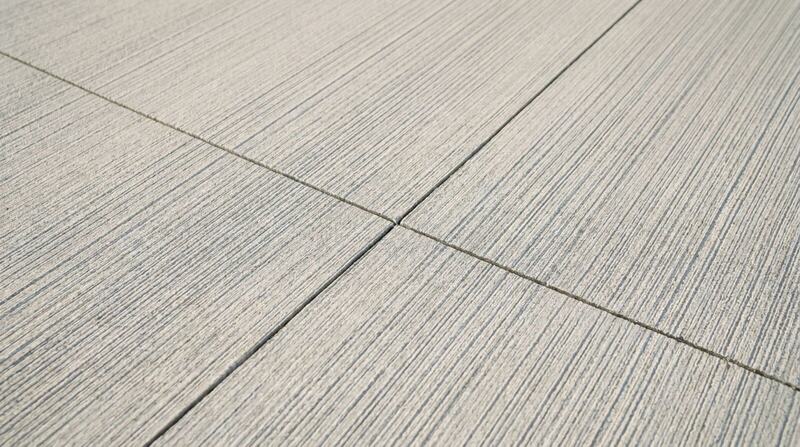 Broom finish: our standard, slip resistant
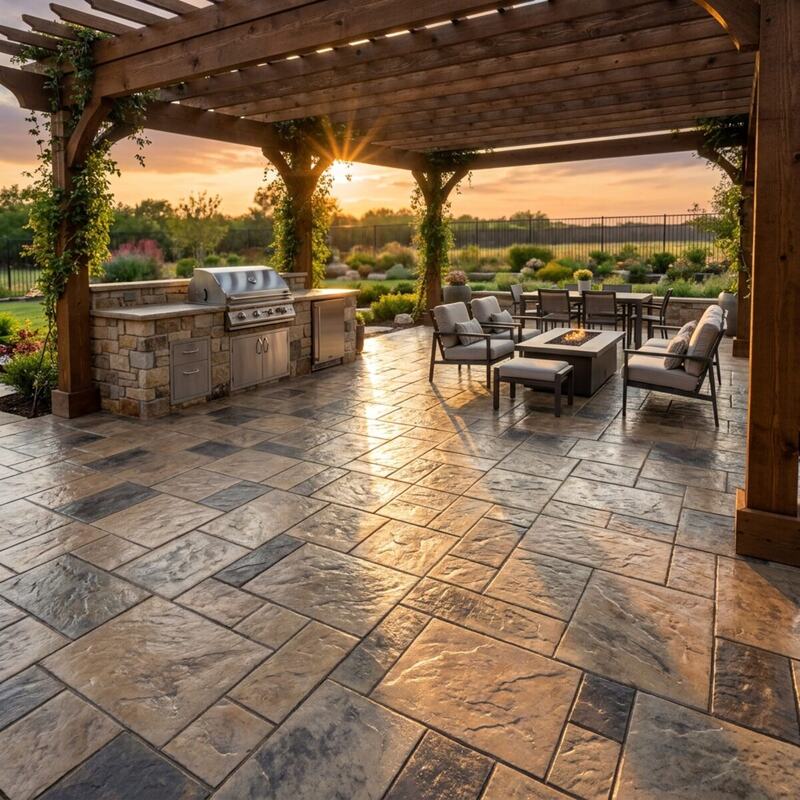 Stamped: pattern and color, sealed
| Finish | Look and feel | Upkeep |
|---|---|---|
| Broom | Clean lines with a light brushed texture for grip. Standard on every driveway. | Lowest. Sealing is optional. |
| Exposed aggregate | Top layer removed to show the stones in the mix. Great traction and hides dirt. Color comes from the stone. | Low. Sealing brings out the color. |
| Salt finish | Small pits pressed into the surface for a subtle, textured look around pools. | Low to moderate. Seal it. |
| Integral color | Color mixed through the whole slab, so chips don't show gray underneath. | Low. Reseal for depth. |
| Stamped | Patterns like slate, stone or wood, with color and release accents. Multi-day install. | Reseal every few years to keep the color and protect the surface. |
How does a patio connect to my house?
A patio sits right against your foundation, so two details matter. It's sloped away from the house, at least an eighth of an inch per foot, so rain runs toward the yard, not under your slab. And it has an isolation joint where it meets the foundation, so the patio and the house can move independently on the clay. If you're planning a cover, pergola or outdoor kitchen later, tell us now. Posts and heavy loads may need thickened footings poured at the same time.
Why does stamped concrete cost so much more?
It's a different job. Stamping means coloring the surface, pressing every inch with heavy mats while the concrete is at exactly the right stage of setting, detailing edges by hand, washing, and sealing. It takes a specialized finishing crew and usually two to three days instead of one. The result is beautiful, but it also needs resealing every few years.
Should I seal my concrete?
Decorative and colored concrete should be sealed, and we include sealer on stamped work. For a plain broom driveway, sealing is optional. It can help resist stains and water absorption. Timing depends on the product: penetrating sealers go on after about a month of curing, and some film-forming sealers go on sooner. Film-forming (acrylic) sealers typically last one to three years, and penetrating sealers last longer.
Can you match my existing concrete or stamped pattern?
We can match a stamp pattern and get close on color, and we'll show you samples first. Exact color matching between new and old concrete is never perfect at first, because the old slab has weathered. It blends more over the first year.
Do you pour pool decks and around pools?
Yes. Pool decks need careful slope away from the pool, joints planned around the coping, and a finish that's not slippery when wet, which is why salt finish and exposed aggregate are popular there. If a pool is being built, we coordinate with the pool builder on timing.
Structural slabs
Foundations, footings and how they differ
A driveway or patio is flatwork: a slab that carries cars and feet. A foundation carries a building, so it's designed by an engineer around your soil and the structure's loads. Here's the short version of how they differ, and where the two meet.
What kinds of foundations are common in DFW?
- Post-tensioned slab: most newer homes in North Texas. Steel cables run through the slab in plastic sleeves and are pulled tight after the concrete gains strength, squeezing the slab so it resists the push and pull of clay. Never cut, core or drill deep into a post-tensioned slab without locating the cables first.
- Conventional rebar slab: a reinforced slab with deeper beams under the edges and interior, common in older homes.
- Pier and beam: the house sits on beams supported by piers, with a crawl space. Common in older neighborhoods.
Can you pour a garage, shed or pergola slab?
Often, yes. Slabs that carry a structure need more than flatwork: a thickened, turned-down edge or footings under posts, heavier steel, and sometimes an engineered design or a building permit with plans. For example, a pergola slab might get heavier rebar on a tighter grid and a thickened edge under the posts. Tell us what's going on top, and we'll tell you whether it needs an engineer's design before we price it.
Do you do foundation repair?
No. Foundation repair (piers, leveling a house) is its own specialty with engineers and lifetime transferable warranties. If you're doing foundation repair and a new driveway, schedule the foundation work first, because lifting a house can crack a fresh slab beside it.
Hiring right
What other crews skip, and how to spot it
Texas doesn't license concrete contractors, so anyone with a truck and a mixer can bid your driveway. Most of the shortcuts below are invisible on day one and expensive by year two. Use this as a checklist for any bid, including ours.
| The detail | The shortcut | How we build it |
|---|---|---|
| Steel | Rebar or mesh laid on the dirt, or "pulled up" during the pour | Rebar tied on 18" centers and set on chairs |
| Thickness | "About 4 inches" that's 3 at the edges, thin aprons | 4" driveway, 6" apron, checked at the forms |
| Base | Dirt raked flat and poured on | Soft spots fixed, base compacted |
| Mix | Water added at the truck to make it easier to spread | 3,500 PSI ready-mix poured as designed |
| Joints | Too few control joints, cut late, or none | Joints spaced for the slab, plus expansion joints where new meets old |
| Tie-ins | New slab butted against the garage with nothing holding it level | Steel dowels into concrete that stays |
| Permit | "You don't need one" | We pull it and schedule the inspection |
| Money | Large cash deposit up front, crew asks to be paid directly | $250 deposit, half before mobilizing, balance after your walk, all through our invoice |
| Warranty | A handshake | One year, in writing, in your agreement |
| Communication | Hard to reach once the deposit clears | One number, start to finish |
How do I compare concrete bids fairly?
Ask every contractor the same questions and get the answers in writing:
- How thick is the driveway, and how thick is the apron?
- What PSI? Ready-mix from a plant?
- Rebar or mesh, what spacing, and is it on chairs?
- What base prep and compaction is included?
- Where will the control joints go? Expansion joints? Dowels into the garage and street?
- Is tear-out and haul-off included? Is the apron included?
- Who pulls the permit?
- What's the payment schedule? Do I ever pay the crew directly?
- What does the warranty cover, for how long, and is it in the contract?
- Do you carry general liability insurance? Can I see the certificate?
A bid that can't answer these clearly is usually cheaper for a reason.
What are the red flags of a bad concrete contractor?
- Wants a big deposit, cash only, or most of the money before starting.
- No written estimate, or one line that just says "driveway, $X."
- Says you don't need a permit for an apron.
- Can't tell you the PSI, thickness or steel spacing.
- No insurance certificate, no reviews, no address.
- Pressure to decide today.
- Rebar sitting on the ground the morning of the pour.
What should I look for on the day of my pour?
You're welcome to watch. Before concrete goes in, you should see forms staked along the edges, base that's been compacted (not soft or muddy), and a tied rebar grid sitting up on chairs, not lying in the dirt. If anything looks off to you, ask the crew lead or text us. We'd rather answer a question before the pour than after.
After we leave
Warranty and long-term care
Your agreement includes a one-year written workmanship warranty from the day we finish, covering how the slab was placed, finished and jointed.
What does the warranty cover?
For one year from completion we stand behind our placement, finish and joint work. Hairline cracks under a quarter inch are normal for concrete and considered cosmetic. Cracks wider than a quarter inch, or where one side has moved higher than the other, we come out and evaluate for coverage.
What it can't cover is the ground itself moving. Expansive clay, a new drainage problem, tree roots growing in later, or damage from heavy trucks before 28 days are outside anyone's control, and no one in Texas can warranty clay. The parts we control (base, steel, thickness, joints) are what make big movement much less likely.
How do I make a warranty claim?
Text photos to (903) 418-2989 with your address. Put a coin or tape measure next to the crack for scale, and include a wider shot showing where it is on the slab. We'll reply, and come look if it needs it. Dated photos make everything simpler, so send them as soon as you notice something.
How do I take care of my new concrete?
- Point downspouts and sprinklers away from the slab edges.
- Keep soil and grass level with the edges so they don't get undercut.
- Skip de-icing salts, especially the first winter. Use sand for traction.
- Clean oil spots promptly. They soak in over time.
- Keep dumpsters, heavy trailers and moving trucks on boards or off the edges, even after 28 days.
- Reseal decorative or stamped concrete every few years.
- Fill or seal joints that open up wide, so water doesn't get under the slab.
How long should a new driveway last?
A well-built concrete driveway commonly lasts 25 to 30 years or more, even on North Texas clay. The biggest factors are the ones in this guide: what's under it, where the steel sits, how it was jointed and cured, and whether water is kept away from its edges.
Still have a question? Just ask.
Text or call the same number from your first question to your final walk. If something in this guide doesn't match your estimate, your estimate and agreement are what count, and we'll explain any difference.